Infinity Mirror
A light sculpture that reads as a clean geometric mirror, right up until you turn it on.
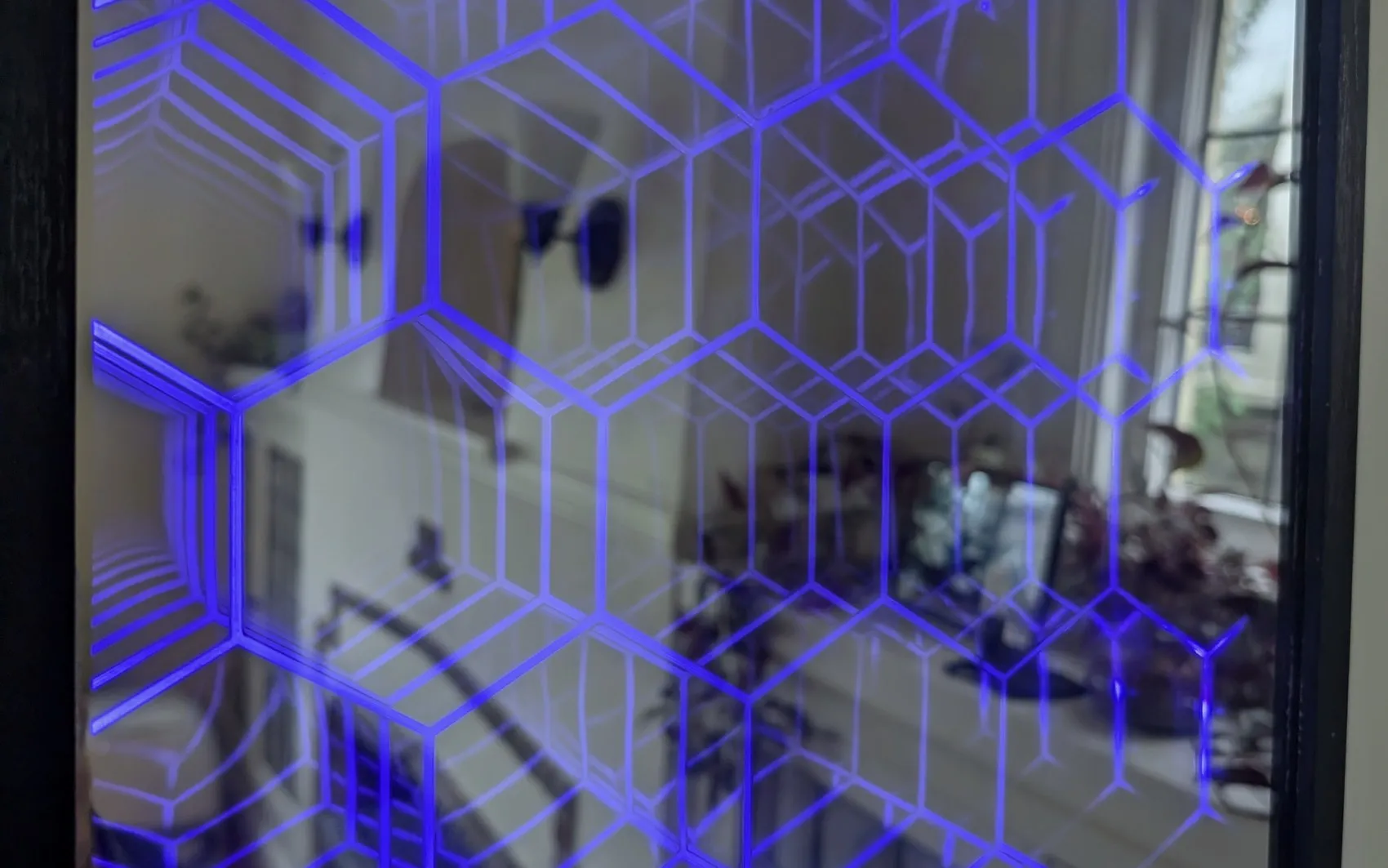
The Infinity Mirror is a light sculpture I designed and built from scratch: hexagonal mirrors, a 3D-printed internal structure, and an ESP32 microcontroller, all fitted inside a 12×12″ shadow box. Half-mirrored glass facing a full mirror bounces each LED’s light back and forth, so the surface opens into a tunnel of light that seems to recede into the wall. Off, it’s a clean geometric mirror. On, it’s the most interesting thing in the room, quietly.
I wanted something that balances engineered precision with ambient warmth, a piece that earns its place in a living space rather than demanding attention from it.
What went into it
- Hexagonal mirror geometry, laid out so the reflections tile cleanly instead of fighting each other.
- A 3D-printed internal frame that holds the glass, LEDs, and electronics in alignment, with no visible fasteners and no extra supports.
- An ESP32 running ESPHome, so the lamp joins the home network and can be controlled, updated, and repaired like something built to last.
- Multiple light modes, from a slow ambient fade to animated color sweeps.
How it turned out
The finished lamp delivers the effect I was chasing: clean reflections, even lighting, and a solid structure. Watching it power on for the first time was the best kind of payoff: digital design, fabrication, and light all agreeing with each other.
It’s also the project that started something bigger. It has since grown into Reflections, a small made-to-order product line under Layered Logic, built and documented as repairable systems, not sealed novelties. Hardening that product’s firmware has been some of the most satisfying engineering I’ve done: first response dropped from 155 to 84 milliseconds, and a 1,476-iteration soak test ran without a single error.
GALLERY
TAKEAWAYS / WHAT I LEARNED
- Modeling the internal frame in CAD before printing meant the glass, LEDs, and electronics all lined up on the first physical assembly, with no visible fasteners.
- Building on ESPHome instead of one-off firmware turned a novelty into something updatable and repairable, which is exactly what let it grow into a product line.
- Getting the off state right mattered as much as the lit effect. A piece earns its place in a room by being calm when it is doing nothing.
BUILT WITH
- Fusion 360
- OrcaSlicer
- ESP32
- ESPHome